MI-HWC visual overview
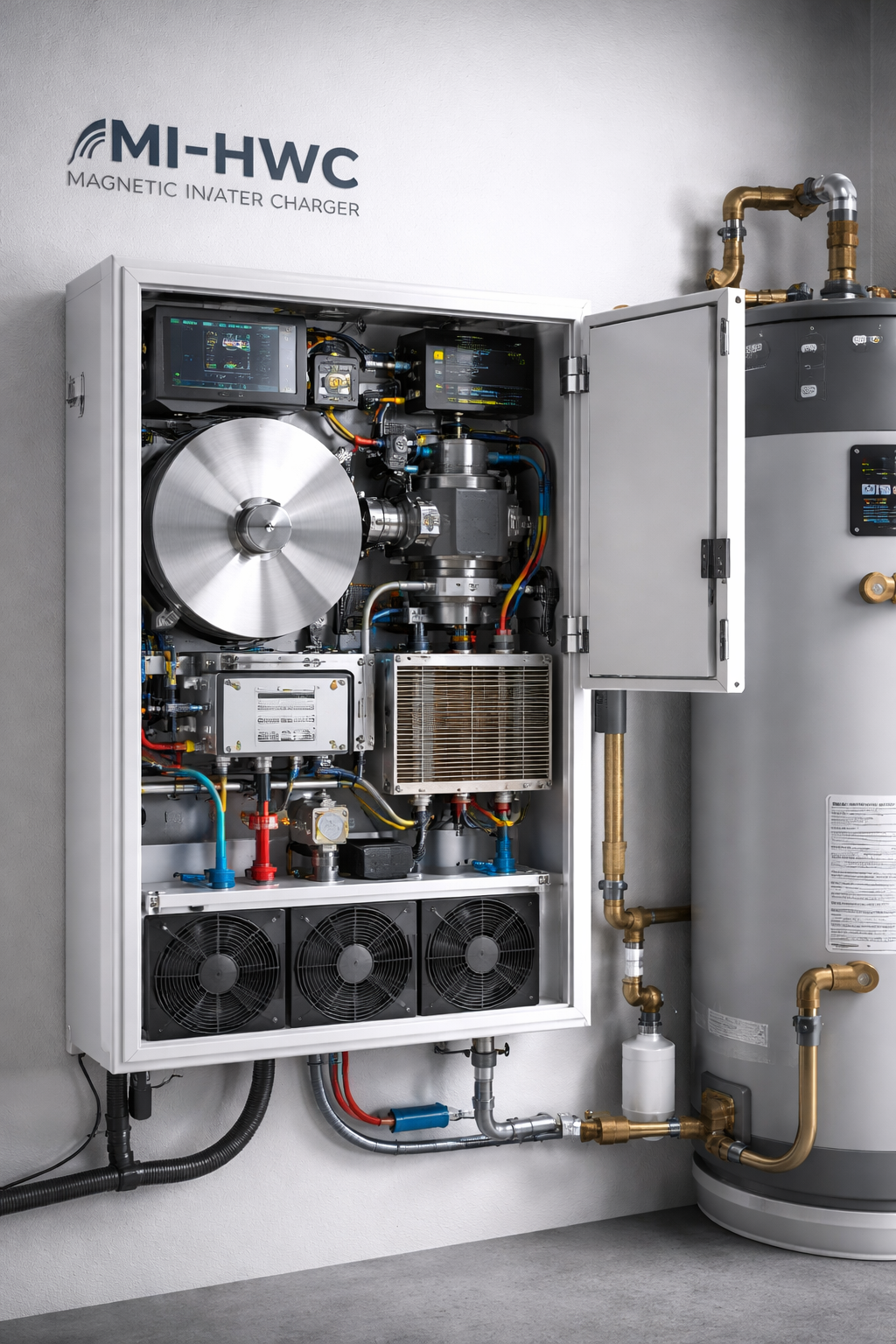
High-resolution renders of the magnetic inertia hot-water charger and its internal thermal routing layout.
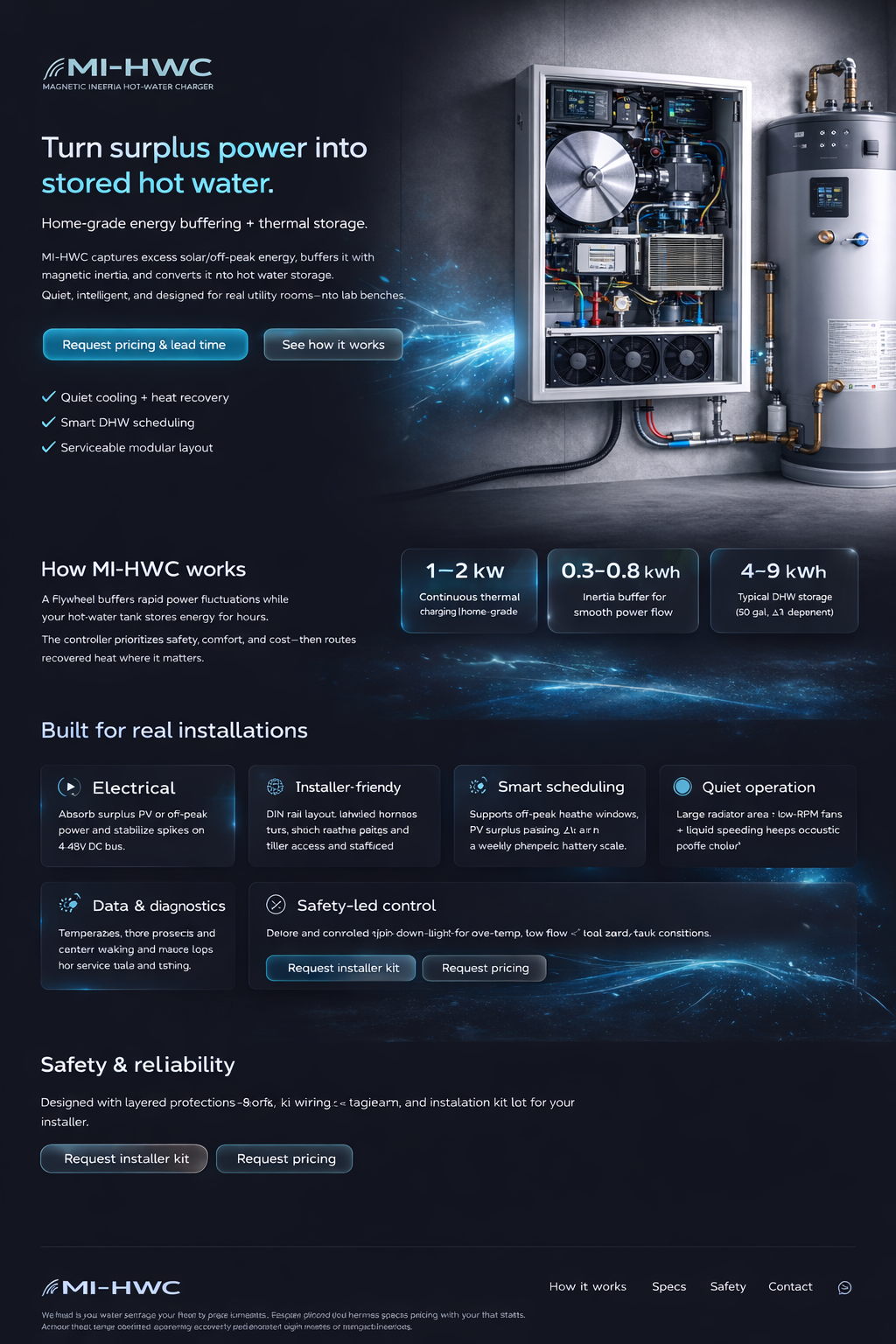
MI-HWC captures excess solar/off-peak energy, buffers it with magnetic inertia, and converts it into hot water storage. Quiet, intelligent, and designed for real utility rooms—not lab benches.
High-resolution renders of the magnetic inertia hot-water charger and its internal thermal routing layout.
A flywheel buffers rapid power fluctuations while your hot-water tank stores energy for hours. The controller prioritizes safety, comfort, and cost—then routes recovered heat where it matters.
Absorb surplus PV or off-peak power and stabilize spikes on a 48V DC bus.
Magnetic inertia smooths short bursts so heating stays stable through dips and clouds.
Route recovered heat into your water tank—your safest, cheapest “battery” at home scale.
Quiet cooling, modular serviceability, and smart controls designed around utility rooms, electricians, and plumbers.
Priority routing sends waste heat into DHW via brazed plate HX—radiator only when tank is satisfied.
DIN rail layout, labeled harness runs, quick-service pump and filter access, and standard plumbing connections.
Supports off-peak heating windows, PV surplus biasing, and a weekly pasteurization cycle.
Large radiator area + low-RPM fans + liquid spreading keeps acoustic profile under control.
Temperature, flow, pressure, and current sensing with event logs for service calls and tuning.
Derate and controlled spin-down logic for over-temp, low-flow, and fault conditions.
These are the home-grade engineering targets for the MI-HWC unit. Production variants can scale up.
We can provide a commissioning checklist, wiring diagram, and installation kit list for your installer.
Estimate how much hot-water energy MI-HWC can capture based on your tank size, temperature rise, and available surplus power.
Estimates assume 100% transfer efficiency for simplicity. Final performance depends on plumbing layout, tank insulation, and control tuning.
Designed with layered protections: sensing, derate control, and controlled spin-down for fault events.
Automatic staged power reduction if inverter baseplate, bearings, or chamber temps trend high.
Flow/ΔT monitoring triggers protective modes if cooling performance drops or pump fails.
Brake + controller logic brings rotor to safe speed without abrupt stops or mechanical shock.
Quick answers to common questions for homeowners, installers, and early adopters.
No. MI-HWC stores and manages energy. The flywheel is a buffer; the water tank is the long-duration storage.
Both. It can bias charging to PV surplus or off-peak grid windows, depending on configuration and local rules.
The flywheel buffers short intervals (0.3–0.8 kWh). Your tank stores the bulk energy (typically 4–9 kWh usable).
Designed to be quiet: liquid cooling + large, low-RPM fans. Target is under 35 dBA at 1 meter in steady state.
Use this form layout as-is, or replace with your CRM embed (HubSpot, Typeform, etc.).
 Ioncore Energy
Magnetic Inertia Systems
Ioncore Energy
Magnetic Inertia Systems